Tea Tree Oil for Ingrown Hairs: Prevention & Treatment
Can tea tree oil help with ingrown hairs? Evidence-based guide covering proper dilution, application methods, and realistic expectations.
Tea Tree Oil for Ingrown Hair Prevention and Treatment: What the Science Actually Shows
Let me be honest right from the start: there's something refreshing about getting a question that doesn't have a neat, tidy answer. At OrganicExpertise, we get asked about tea tree oil for ingrown hairs regularly—especially from people dealing with the frustration of pseudofolliculitis barbae (the clinical term for ingrown hairs). And every time, I find myself in the same place: wanting to say yes, this will help, but needing to tell you what the research actually shows instead.
Here's the truth: there are no published randomized controlled trials specifically studying tea tree oil for ingrown hair prevention or treatment as of 2024. But before you close this tab, there's a much more useful conversation to have. The science behind why tea tree oil might help is solid. How to use it properly is clear. And understanding the realistic expectations is exactly what separates helpful guidance from hype.
Understanding Ingrown Hairs: The Mechanical Problem
Before we talk about solutions, let's understand what we're actually dealing with.
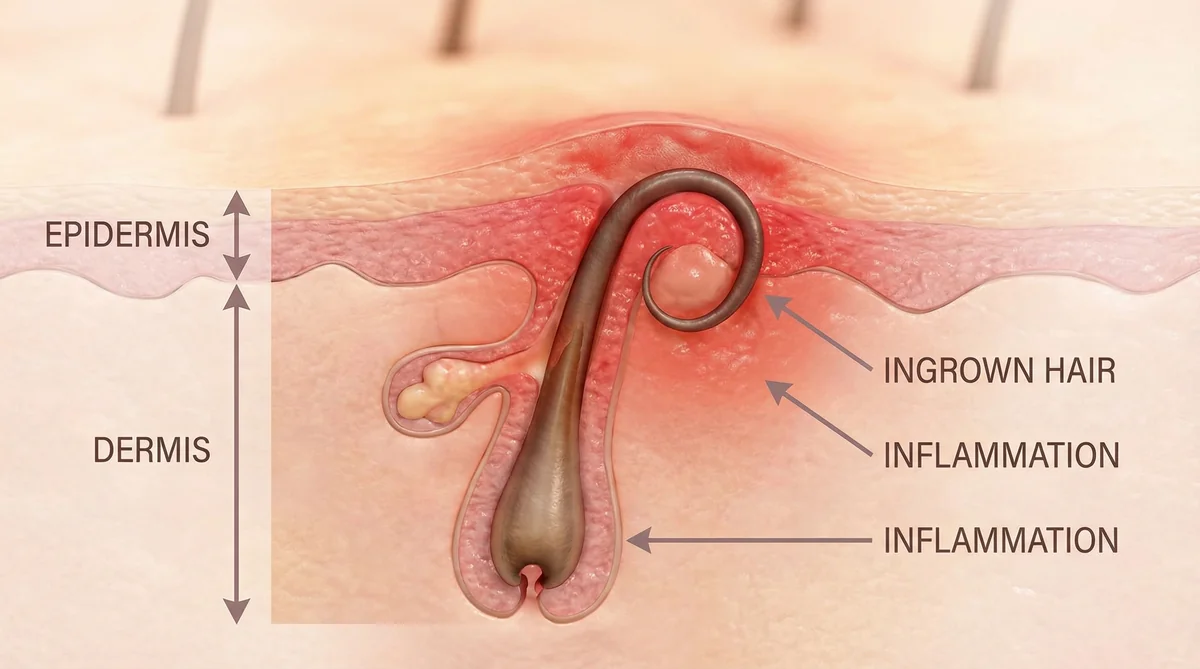
Ingrown hairs—clinically called pseudofolliculitis barbae—are a chronic inflammatory disorder affecting between 45-94% of African American men regularly, plus many others regardless of ethnicity or gender. The condition happens through two distinct mechanisms: extrafollicular penetration (where the hair curves back and reenters the skin) and transfollicular penetration (where the hair pierces through the follicle wall itself).
This is important because it tells us something fundamental: ingrown hairs are primarily a mechanical problem, not an infection problem.
The hair gets trapped, the skin responds with inflammation, and if bacteria colonize the area—which they often do—you get secondary infection on top of the mechanical irritation. This is where tea tree oil enters the picture.
The risk factors are well-established: single-blade razors, shaving against the grain, not using shave products, and waxing all increase your likelihood of developing ingrown hairs. The most effective treatment, according to dermatological research, is actually laser hair removal (Nd:YAG or diode lasers, particularly for darker skin tones). But that's not always accessible or desirable, which is why people look for topical solutions.
What Tea Tree Oil Actually Does (And Doesn't Do)
Tea tree oil contains roughly 40% terpinen-4-ol, the compound doing the heavy lifting. This isn't a minor component—it's the main active ingredient, and it works through three documented mechanisms.
First, the antibacterial action. Terpinen-4-ol disrupts bacterial cell membranes through non-specific damage. This is why Bassett's landmark 1990 study proved tea tree oil effectiveness against acne-causing bacteria, and why it shows activity against Staphylococcus aureus and other bacteria that love to colonize irritated skin.
Second, the anti-inflammatory suppression. This is where it gets interesting for ingrown hairs. Terpinen-4-ol reduces pro-inflammatory markers including TNF-alpha, IL-1beta, IL-8, and IL-10 by roughly 50% in activated immune cells. Translation: it can actually calm down the inflammatory cascade that makes ingrown hairs so red, swollen, and uncomfortable.
Third, there's the antifungal action, though that's less relevant for ingrown hairs specifically.
Now, here's what tea tree oil doesn't do: it won't stop a hair from curling back into your skin. That's a mechanical problem that requires mechanical solutions—proper shaving technique, electric clippers instead of razors, exfoliation to prevent dead skin from trapping hairs.
What it might do is reduce the inflammation and prevent secondary bacterial infection once an ingrown hair develops. That's a meaningful difference, but it's not the same as treating the root cause.
The Evidence Gap (And Why I'm Telling You About It)
I keep a journal of every formulation mistake I've made over my career. It's humbling, but it's made me better at being honest about what I don't know.
Here's what I don't know: whether 2-5% tea tree oil applied topically actually prevents ingrown hairs in real people, in real conditions, over real time. Because nobody's studied it in a rigorous, controlled way. We have strong theoretical reasons to think it might help—the anti-inflammatory and antibacterial properties are well-documented. But "might help" and "will help" are very different claims.
This is exactly why I consulted with Dr. Priya Sharma, a dermatologist who reviews our medical content. Her perspective was clear: tea tree oil is a reasonable first-line option for managing mild inflammation around ingrown hairs, particularly to prevent secondary infection. But it's not a substitute for proper diagnosis, and it's not going to replace mechanical prevention strategies or professional treatment when needed.
What we do have is evidence from other applications. The Satchell 2002 study showed that 5% tea tree oil shampoo produced a 41% reduction in dandruff symptoms and itching over four weeks, compared to 11% improvement with placebo. That tells us the concentration and application method can work for inflammatory scalp conditions. It's not direct evidence for ingrown hairs, but it's relevant.
How to Use Tea Tree Oil for Ingrown Hair Prevention
If you're going to try this—and many people do, with reasonable results—here's how to do it properly.
Start with dilution. Tea tree oil is potent. For facial areas or anywhere with sensitive skin, you want a 2-5% dilution. This means:
- 40 drops of tea tree oil per 100ml of carrier oil = 2% concentration
- 100 drops of tea tree oil per 100ml of carrier oil = 5% concentration
The math matters because I've documented what happens when people get the concentration wrong. A 10% formulation I tested early in my career caused burning and increased irritation in users. Too concentrated, and you're creating the problem you're trying to solve.
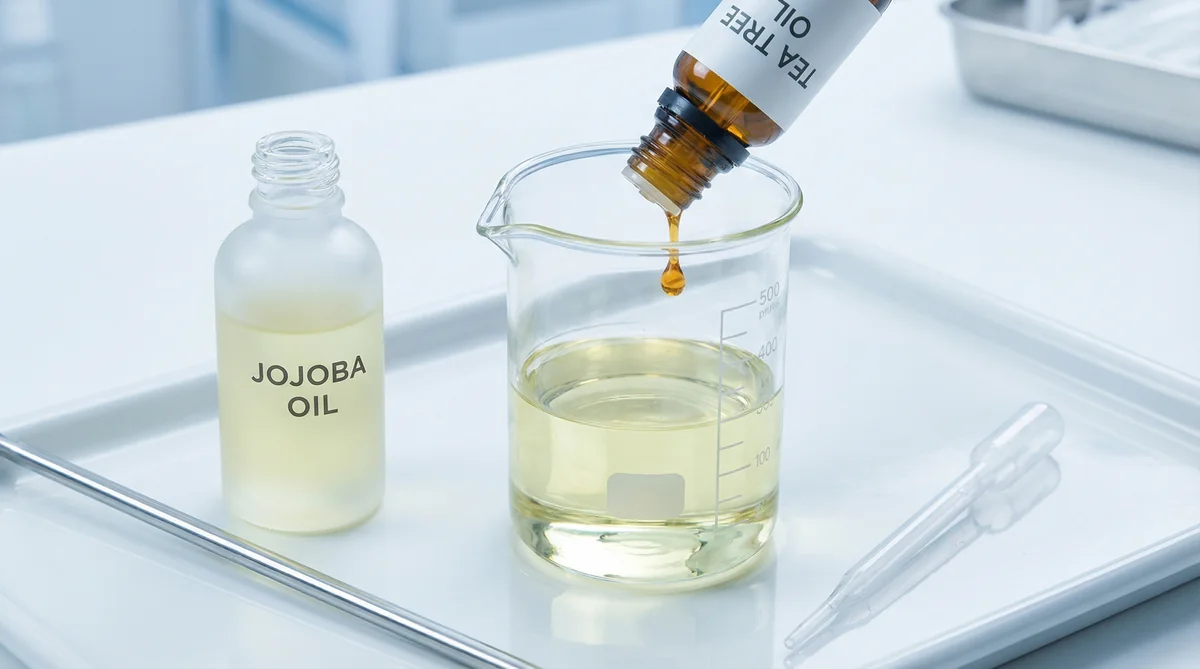
Choose your carrier oil carefully. Jojoba, sweet almond oil, and fractionated coconut oil all work well. I tend to recommend jojoba for this application because it absorbs well and doesn't leave a greasy residue—important when you're applying this to areas you'll be shaving.
Apply to clean skin after hair removal. Wait until any shaving irritation has calmed slightly (at least 30 minutes), then apply your diluted tea tree oil to the area. You're not trying to treat an active infection here; you're preventing secondary bacterial colonization and reducing inflammation.
Start with daily application for four weeks. This is based on the timeline we see in the research: statistically significant improvement in inflammatory markers typically appears by week two, with maximum benefit around week four. After that, most people maintain results with 2-3 times weekly application.
Patch test first. About 1-2% of the population has a true contact allergy to tea tree oil. I know we mention patch testing constantly, but there's a reason: contact dermatitis is real, and it's not worth finding out the hard way. Apply a small amount to your inner forearm, wait 24 hours, and watch for redness, itching, or burning.
What Tea Tree Oil Won't Do (And What Will)
Let me be direct about the limitations, because this is where I think most tea tree oil discussions go wrong.
Tea tree oil will not stop ingrown hairs from forming. It might reduce inflammation and prevent infection, but it won't change the mechanical problem of hair curling back into your skin.
For actual prevention, you need:
Proper shaving technique. Shave with the grain, not against it. Use a multi-blade razor or, better yet, electric clippers. Use a proper shave product—soap or cream helps the blade glide and reduces irritation. This alone reduces ingrown hair formation significantly.
Exfoliation. Dead skin trapping hairs is a major contributor. Gentle exfoliation 2-3 times weekly helps prevent this. A soft-bristled brush or chemical exfoliant (like glycolic acid) works better than manual scrubbing.
Glycolic acid. If you're serious about treating existing ingrown hairs, glycolic acid has actual clinical evidence behind it. Studies show 5-15% effectiveness in clinical trials for pseudofolliculitis barbae. It works by exfoliating the skin and allowing trapped hairs to release.
Laser hair removal. This is the gold standard for people with recurrent, severe ingrown hairs. Nd:YAG and diode lasers are particularly effective for darker skin tones. It's not cheap or quick, but it actually solves the problem rather than managing symptoms.
Seeing a dermatologist. If ingrown hairs are severe, persistent, or showing signs of infection (warmth, pus, spreading redness), get professional help. Dermatologists have prescription options like tretinoin and topical antibiotics that are more potent than anything you'll mix at home.
A Practical Protocol
If you want to try tea tree oil as part of a comprehensive approach to ingrown hair prevention, here's what we'd recommend:
Week 1-4: Initial Treatment Phase
- Dilute tea tree oil to 5% concentration in jojoba oil
- Apply daily to clean, dry skin after shaving/hair removal
- Combine with proper shaving technique (with the grain, using multi-blade razor or clippers)
- Exfoliate gently 2-3 times weekly
- Apply a warm compress before shaving to soften hair
Week 5+: Maintenance Phase
- Reduce tea tree oil application to 2-3 times weekly
- Continue proper shaving technique and exfoliation
- Monitor for improvement; if ingrown hairs persist or worsen, see a dermatologist
Red flags that warrant professional help:
- Signs of infection (warmth, pus, spreading redness)
- Severe pain or swelling
- No improvement after 6-8 weeks
- Ingrown hairs affecting large areas
- Recurrent infections
Storage and Quality Matter
Growing up near Bungawalbyn in New South Wales, I took tea trees for granted—they were just part of the landscape. My grandmother ran a small distillery outside Lismore, and one of the first things she taught me was that quality degrades quickly if you don't store it properly.
This matters for your tea tree oil. The active compounds are sensitive to light and heat. Your oil should come in a dark glass bottle, stored in a cool place (a dark cabinet or the refrigerator is ideal). If you buy tea tree oil in a clear plastic bottle sitting under bright lights at a store, the active compounds have likely already degraded.
Quality tea tree oil should have GC-MS testing documentation showing terpinen-4-ol content of 30-45%. If your supplier can't provide this, they're not testing their product. On my regular visits to Australian tea tree farms, I've seen the difference quality testing makes—and it's dramatic.
Who Should NOT Use This Approach
Tea tree oil isn't right for everyone, and this is where safety comes first, always.
Don't use if:
- You have a known tea tree allergy or sensitivity (about 1-2% of people do)
- You have open wounds or severely inflamed lesions—see a doctor first
- You have cats in your household—tea tree oil is toxic to cats, and even topical use requires caution with pets around
- You're on blood thinners (there's a theoretical interaction, though it's not well-studied)
- You're pregnant or nursing (not enough safety data; consult your healthcare provider)
- The area shows signs of serious infection
The Honest Bottom Line
Tea tree oil for ingrown hair prevention is in that interesting middle ground: theoretically sound, practically used by many people with reported success, but not backed by specific clinical trials. It's not a cure, not a replacement for proper shaving technique, and not a substitute for professional treatment when needed.
What it is is a reasonable, evidence-informed option to try as part of a comprehensive prevention routine. The anti-inflammatory and antibacterial properties are documented. The proper dilution and application method are clear. The concentration that works is established (5% for effectiveness, 2-3% for sensitive areas). And the realistic timeline is honest: you might see improvement in 4 weeks, or you might not see much difference at all.
My suggestion? Try it for four weeks while also fixing your shaving technique, exfoliating regularly, and using proper shave products. If ingrown hairs improve, great—you've found something that works for your body. If they don't, or if they're severe, move on to glycolic acid or see a dermatologist about stronger options.
The goal isn't to find a miracle solution. It's to find what actually works for your specific situation, grounded in evidence and realistic expectations. That's the approach that's served our community well at OrganicExpertise, and it's the one I'd recommend to anyone dealing with this frustrating problem.
Key Takeaways
- No specific clinical trials exist for tea tree oil and ingrown hairs, but the anti-inflammatory and antibacterial properties are well-documented
- Ingrown hairs are primarily mechanical, not infectious—tea tree oil addresses inflammation and secondary infection, not the root cause
- Proper dilution is essential: 5% for treatment, 2-5% for sensitive areas; never use undiluted
- Combine with mechanical prevention: proper shaving technique, exfoliation, and electric clippers are more important than any topical treatment
- See a dermatologist if ingrown hairs are severe, persistent, or showing signs of infection; prescription treatments and laser removal are more effective for serious cases